
Work and Adventure, Worldwide: Julia's journey to the highest mountain in Oceania
Some dreams begin quietly – and grow with every step you take outside your comfort zone. For Julia, an employee at SGS Industrial Services, just such a dream became reality in October: She stood on the summit of the Carstensz Pyramid in West Papua – the highest mountain in Oceania and one of the most technically challenging destinations of the Seven Summits.
Between international assembly projects, long workdays, and the challenge of balancing career, training, and personal goals, Julia embarked on a true adventure. Her story impressively demonstrates what's possible when courage, discipline, and passion meet the right circumstances.
We spoke with Julia about her adventure.
Eine Expedition ans Ende der Welt
Julia, you climbed the Carstensz Pyramid in October – how did the idea for this expedition come about?
After my ascents of Kilimanjaro and Aconcagua, it was clear to me: I needed a new goal. When I descended from Aconcagua in January, I asked myself, as always: What's next? The Carstensz Pyramid had reopened to climbers after several years. It's one of Reinhold Messner's Seven Summits – and technically far more demanding than my previous climbs. For me, it was the next logical step. W
What makes this mountain so special?
The Carstensz Pyramid is difficult to reach, politically sensitive, and surrounded by many prejudices. Previously, climbers trekked through the jungle to reach base camp – today, access is by helicopter. The abrupt change in altitude, the technical climbing, and the history of this region make the mountain truly exceptional. It's not a typical trekking destination – but a challenge that demands respect.
Vorbereitung zwischen Baustelle und Berg
What did your preparation look like – physically, mentally, and logistically?
The biggest challenge was definitely the organization. Anyone who works on a construction site with long days and Saturdays knows: time is a precious commodity. I planned my training weeks meticulously, prepared meals, and for each new project, I always made sure to find the nearest gym, running trails, or climbing wall. I'm especially grateful for the support from the project team: on my last project, I was able to take more frequent, shorter breaks – which allowed me to gain valuable climbing experience in the Alps during the summer. This shows me that at SGS, a lot is based on communication and trust. You have to talk to each other. I didn't have any mental preparation in the traditional sense. Working on international construction sites is training enough: dynamic environments, time pressure, responsibility. It's not that far removed from a summit day.
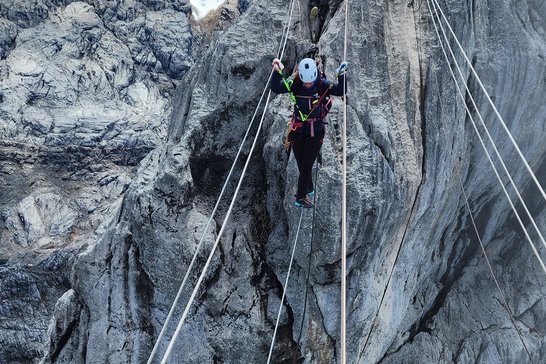
“I knew: That’s exactly why I did it.”
Was there a moment when you knew: This was worth it?
At the summit itself, it was primarily relief—and the thought that I wouldn't want to cross that ridge again. The real feeling came later at base camp: that inner lightness because it was done. In the months leading up to it, there were many doubts: Is the agency reputable? Is the country too dangerous—especially for a woman alone? Wouldn't the money be better spent elsewhere? In the end, I knew: I did exactly what I had to do. And I wish everyone could experience that feeling of self-efficacy at least once.
International projects, international perspectives
You work on international projects at SGS Industrial Services. What do you particularly appreciate about that?
My tasks vary depending on the project – from quality control and logistics to administration and communication with clients and management. We help each other and complement one another. What motivates me are the people and the challenges. I enjoy working with colleagues who have more experience than I do – I can learn from them. Openness is crucial, especially in international teams. Different cultures, ways of thinking, and realities come together. You don't have to understand or approve of everything – but you do have to respect it. That's how collaboration works.
Parallels between mountain and construction site
What connects your work at SGS to mountaineering?
Teamwork, planning, perseverance – and dealing with uncertainty. In the mountains, as in projects, chaos often reigns. It's important not to jump to conclusions, but to give yourself time. Emotional intelligence plays a crucial role: recognizing when there is real danger – and when it's "just" fear. On the Carstensz Pyramid, I set off with people I barely knew. Trust was essential. Just like in everyday project work: no one reaches the summit – or a project goal – alone.
Looking ahead
What are you taking away from this expedition for yourself and your work?
Gratitude – for the opportunities I have and for the path I've already traveled. I know where I come from, and I know that many things aren't a given. When you make decisions that truly resonate with you, even taking risks feels like freedom. And yes: The next goal is already set. But I'd rather talk about that when the time is right.
Danke, Julia!
With her courage, discipline, and forward-thinking approach, Julia embodies our motto "Work and Adventure, Worldwide" in an impressive way. We are proud to have a colleague on the #SGSteam who demonstrates that international work, personal development, and big dreams are not mutually exclusive—but rather mutually reinforcing.